

Digital Nomad Statistics 2026: How Many Digital Nomads Are There?
Discover comprehensive 2026 data on digital nomad salaries, demographics, top destinations, employment trends, and why 41 countries now offer visas to attract this $940 billion workforce.

This article may contain affiliate links, meaning I make a small commission on any purchases at no extra expense to you. Read our disclaimer & privacy policy here.

Matthew Metcalfe
January 19, 2026
There are 43 million digital nomads worldwide, and they contribute approximately $940 billion per year in direct economic spending.
The digital nomad movement is no longer a trend; it’s a recognised lifestyle that millions of people join every year!
As remote work becomes a normal part of life, people crave new adventures in new locations. The digital nomad lifestyle is attractive so the movement continues to explode.
Even governments are on board, with 41 countries now offering digital nomad-friendly visas to attract an ever-growing remote workforce.
These 2026 digital nomad statistics tell the whole story of what the digital nomad lifestyle looks like in reality. Strap yourself in as we dive deep into the digital nomad life.
Key Digital Nomad Statistics For 2026
Here are the digital nomad statistics you need to know:
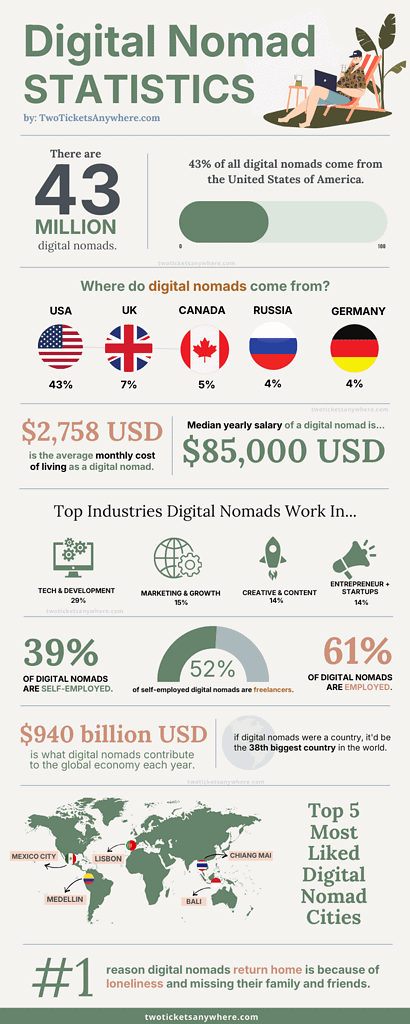
Check out the digital nomad statistics infographic below for a visual representation of some of these top stats.
Now let’s jump in!
How Many Digital Nomads Are There Worldwide?
There are now an estimated 43 million digital nomads worldwide as of 2026.
This is expected to grow significantly over the next few years, with estimates as high as 80 million worldwide digital nomads by the end of 2030.
If digital nomads were a country, they would be the 38th-largest country in the world.
The digital nomad movement is no longer just a trend to travel more. It has become a recognised lifestyle that millions of people embrace.
How Many Digital Nomads Are From the United States?
There are now 18.5 million US digital nomads worldwide, with US digital nomads making up 43% of the entire nomad population.
This is a huge result, considering in 2018 only 4.8 million Americans identified as digital nomads.
This is the breakdown of total US digital nomads by year:
| Year | Number Of US Digital Nomads |
|---|---|
| 2018 | 4.8 Million |
| 2019 | 7.3 Million |
| 2020 | 10.9 Million |
| 2021 | 15.5 Million |
| 2022 | 16.9 Million |
| 2023 | 17.3 Million |
| 2024 | 18.1 Million |
| 2025 | 18.5 Million |
Between 2019 and 2021, the digital nomad movement grew by a huge 49% with 10.9 million nomads from the US.
Why is the growth so fast?
More working flexibility and the ability to work from anywhere in the world! The Covid-19 pandemic also fuelled remote working and travel as lots of US citizens went to countries with more relaxed laws and less threat of lockdowns.
It’s worth noting that the growth in digital nomads from the United States has slowed between 2024 and 2025, growing at just 2.2%.
It’s likely that as many people have returned to the office, at least in a hybrid setting, the ability for people to travel full-time has decreased.
Global Economic Impact of Digital Nomads
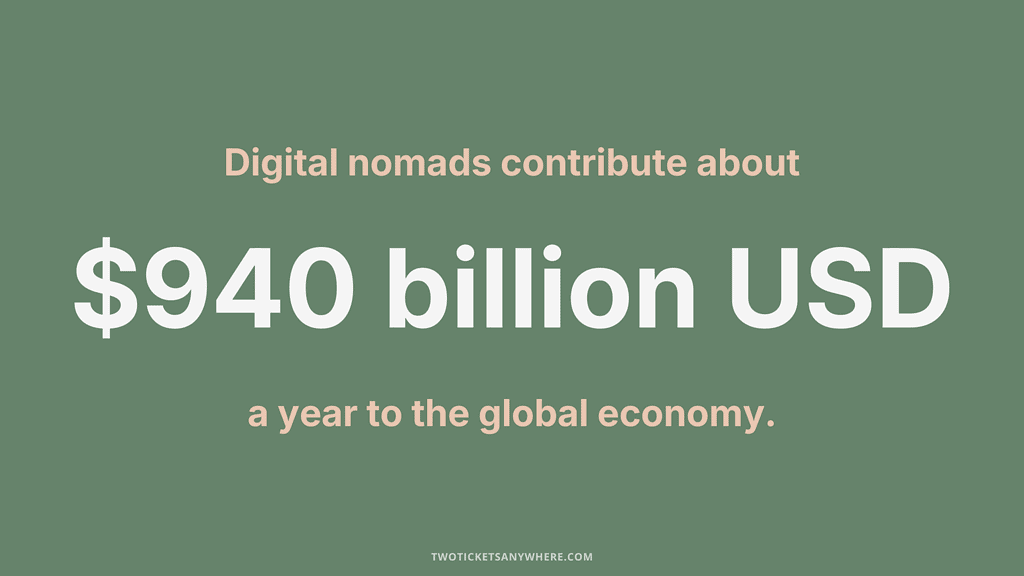
Digital nomads contribute an estimated $940 billion per year to the global economy through direct economic spending.
Which country wouldn’t want a slice of that?
Think about it…
Most digital nomads earn money from their home countries. They then take that money and spend it in a foreign country. That means that the foreign country receives the economic benefits of a digital nomad without having any obligation to them.
If digital nomads were a country, they would be the 22nd biggest economy in the world.
Digital Nomad Income and Salary Statistics
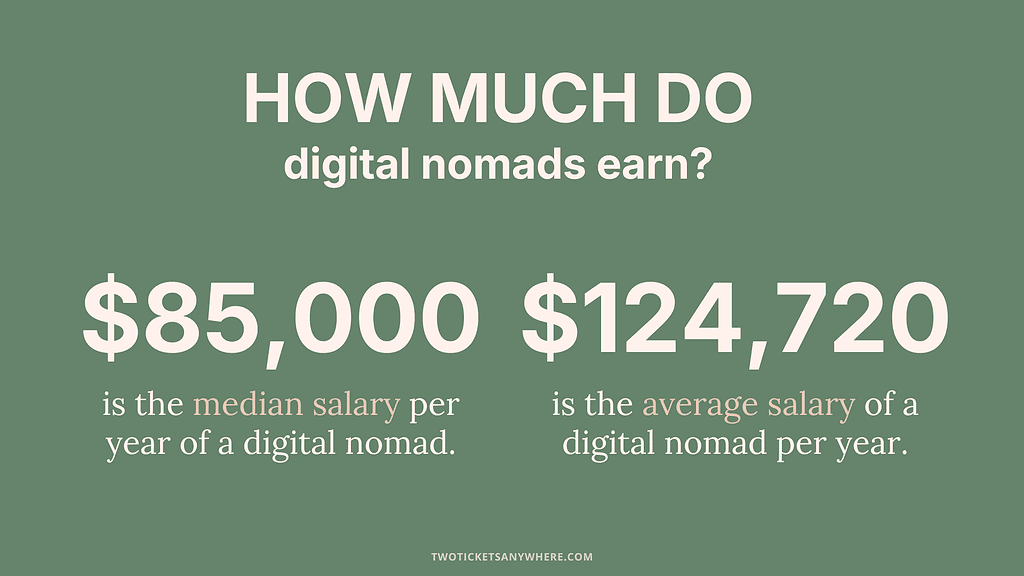
Digital nomads earn an average salary is $124,720 per year, with the median salary at $85,000 per year.
69% of digital nomads’ annual income is between $50k and $250k. The average monthly income of a digital nomad is about $10,393, although the median income works out far less at $7,083 per month.
The truth is that digital nomads can earn more than they did in a corporate job.
These are the latest digital nomad statistics on salary:
| Annual Income Range | Percentage (%) of Digital Nomads |
|---|---|
| Less Than $25k | 6% |
| $25k – $50k | 15% |
| $50k – $100k | 34% |
| $100k – $250k | 35% |
| $250k – $1M | 9% |
| Over 1+ Million | 2% |
Source: Nomads.com
The average income in the United States is $66,622, and the median income is $61,984.
This means that most digital nomads make more than the average US worker.
But not everything is sunshine and rainbows. 32% of digital nomads said they have received financial support from outside sources like friends or family to help make ends meet.
49% of digital nomads said they earn the same or more than when they worked in traditional corporate jobs.
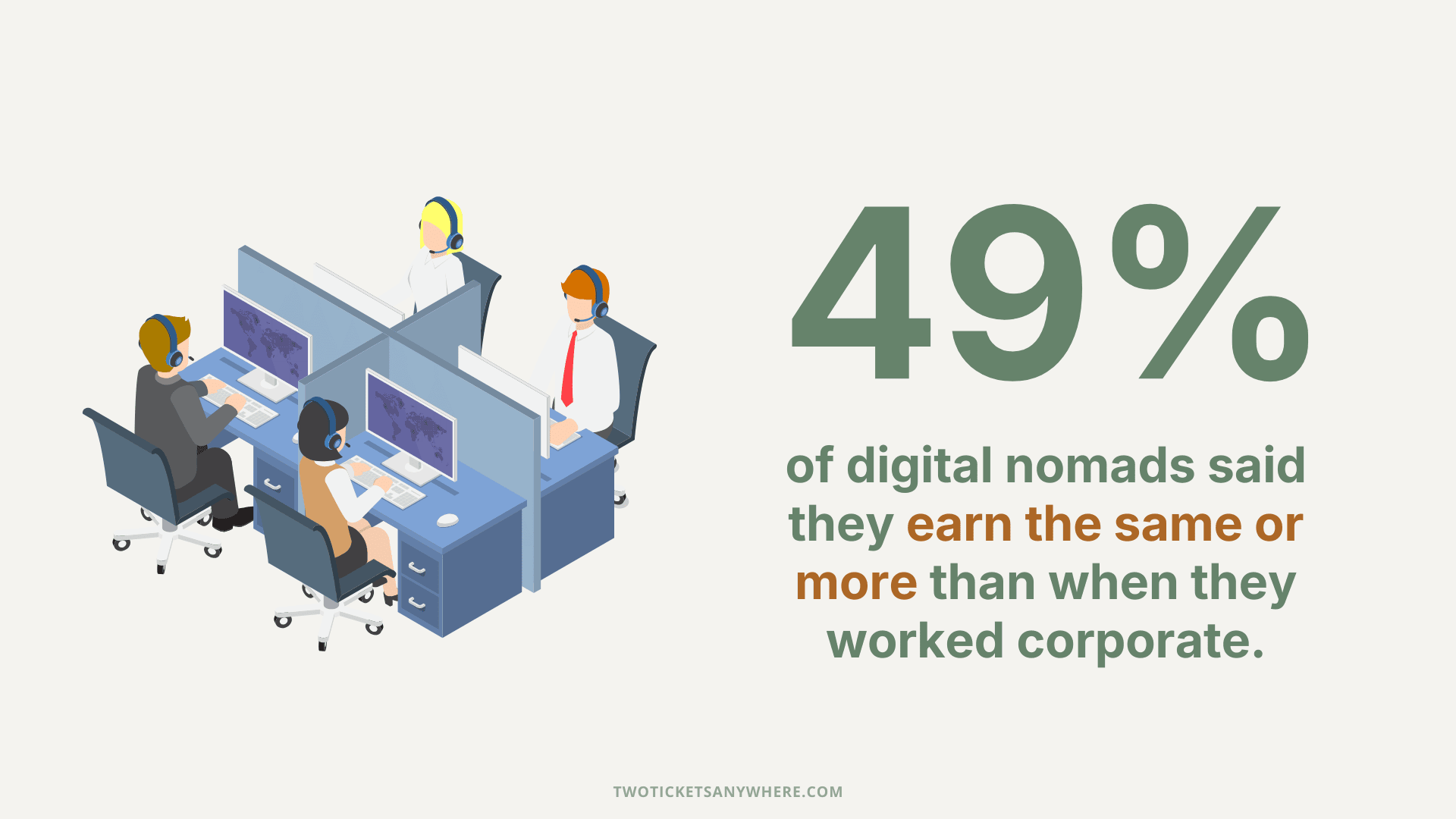
31% said they make similar amounts of money. 38% of digital nomads said they don’t feel as stressed about money anymore and 34% said there has been a change.
I guess it’s more or less based on the kind of person you are.
With that said, 81% of digital nomads are satisfied with their earnings:
- 41% are very satisfied with their earnings
- 40% are satisfied with their earnings
That means about 19% of digital nomads wish they could make more money.
The big takeaway here is that digital nomads generally earn well and are happy with what they make.
Digital Nomad Demographics and Lifestyle
As you can imagine, relationships can be a bit of a challenge for digital nomads.
Although lots of digital nomads travel as a couple, many nomads are looking for love as they move from place to place. The following demographic and relationship digital nomad statistics paint a very good picture of who digital nomads are.
Are There More Male Than Female Digital Nomads?
59% of digital nomads are male, while 41% are female. There has always been a skew towards males when it comes to digital nomad demographics.
But that gap is closing fast.
More women are embracing location-independent work every year and it’s like that we will see this even out over the next few years.
What Is the Average Age of a Digital Nomad?
There is no doubt that digital nomad life is more popular among younger adults.
The average age of a digital nomad is 38 years old.
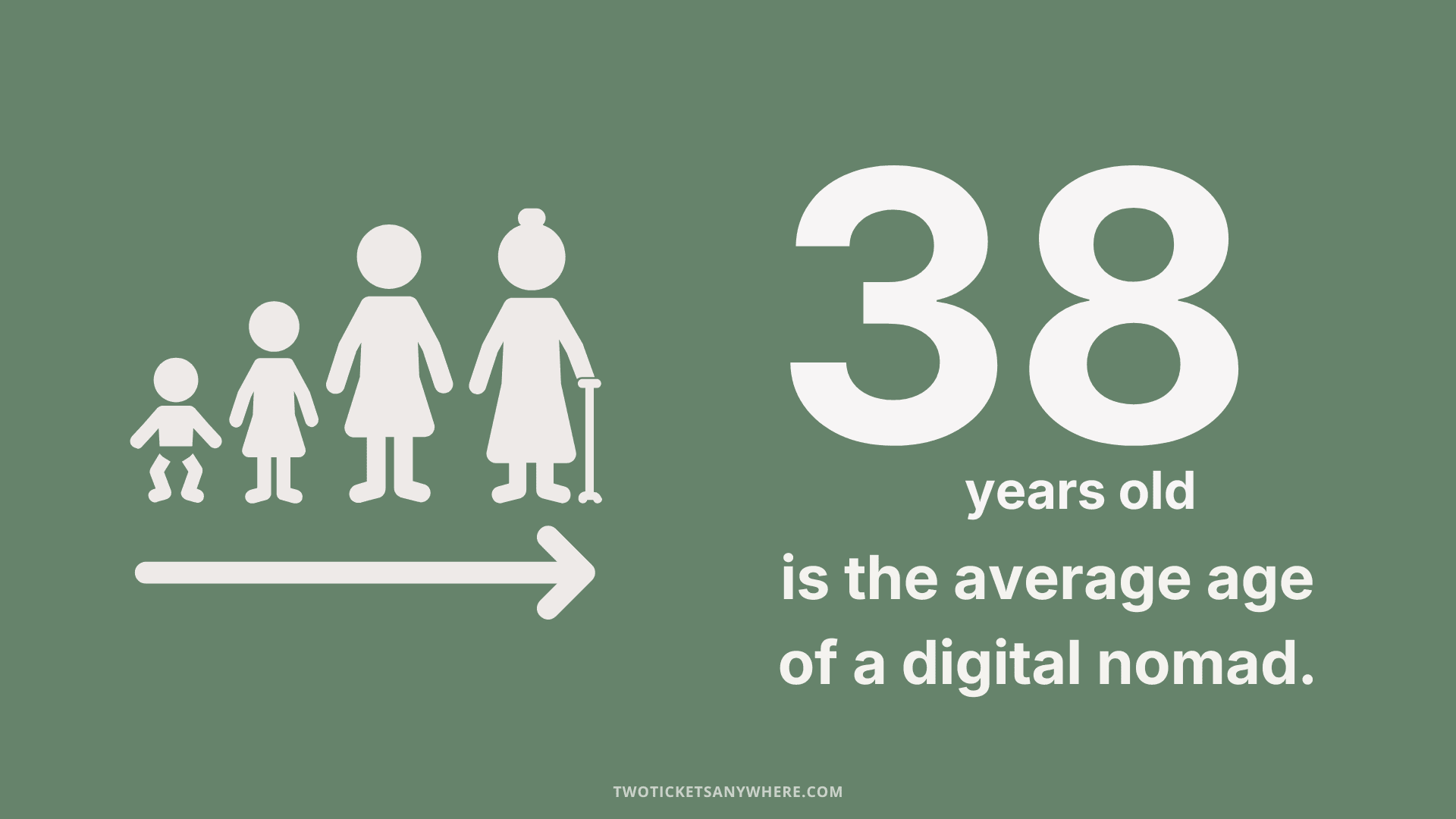
Most people start their digital nomad journey in their early 30s. And there seems to be a pretty big reason for that…
25% of people burn out before the age of 30, with the average age of burnout being 32 years old.
What’s more?
Most people start feeling the negative effects of corporate work-life balance in their early 30s. That’s the exact moment when the 9-to-5 grind starts to feel like a trap.
Remember that 73% of people become nomads because they want a better work-life balance. It’s not a coincidence that 58% of all digital nomads are aged 25 to 44.
Here’s the full breakdown of the age of digital nomads worldwide:
| Age Group | Primary Generation(s) | Share of Digital Nomads |
|---|---|---|
| 18–24 | Gen Z | 12% |
| 25–34 | Gen Z, Millennials | 30% |
| 35–44 | Millennials | 28% |
| 45–54 | Gen X | 19% |
| 55+ | Gen X, Boomers+ | 11% |
Reconciled data sources: Statista, MBO Partners. Note: Shares are estimated by reconciling generational and age-band distributions.
Interestingly, there are more digital nomads in their 50s than there are in their 40s. There is also a significant drop-off after the age of 60 years old.
It makes sense as being “nomadic” is significantly harder the older you get.
Which Countries Do Digital Nomads Come From?
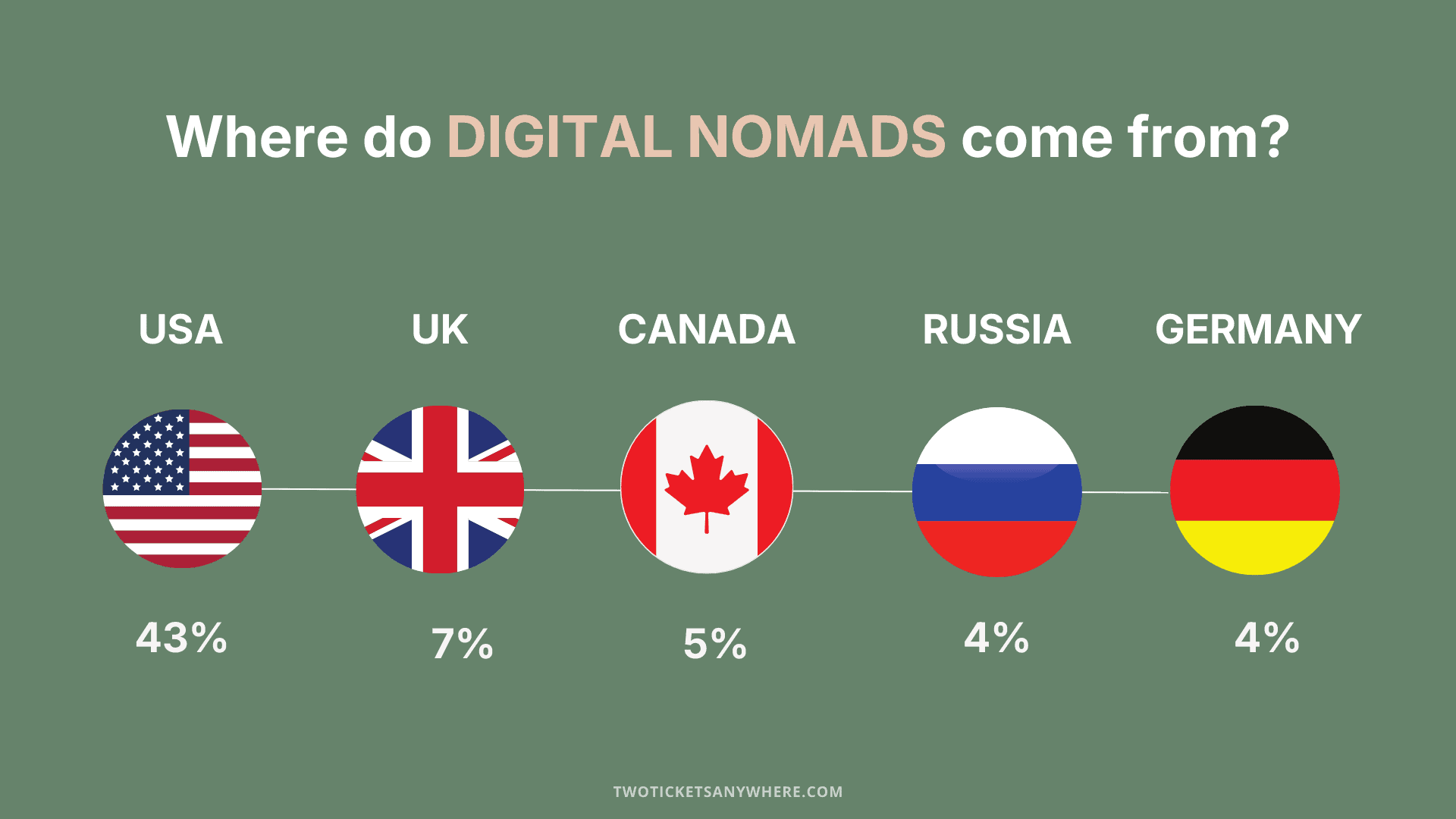
43% of all digital nomads come from the United States.
This is followed by the United Kingdom with 7% and Canda making up 5% of the digital nomad population. The next two nationalities are Russia at 4% and Germany at 4%.
Here are the top 15 countries that digital nomads come from:
| Country | Percentage (%) |
|---|---|
| United States | 43% |
| United Kingdom | 7% |
| Canada | 5% |
| Russia | 4% |
| Germany | 4% |
| France | 3% |
| Brazil | 3% |
| Australia | 2% |
| Netherlands | 2% |
| Spain | 2% |
| India | 2% |
| Ukraine | 1% |
| Italy | 1% |
| Poland | 1% |
| Switzerland | 1% |
Source: Nomads.com
If you break it down by regions, it gets more interesting:
| Region | Share of Digital Nomads |
|---|---|
| Northern America | 48% |
| Europe | 32% |
| Asia | 6% |
| Latin America & Caribbean | 5% |
| Oceania | 2% |
| Africa | 1% |
Source Data: Nomads.com; calculations by TwoTicketsAnywhere. Percentages do not sum to 100% because nationality data is only available for a subset of countries.
North America makes up 49% of digital nomads worldwide, with Europe coming in second with 29%. Just 22% of digital nomads come from other regions of the world.
Are Digital Nomads Single or in Relationships?
65% of digital nomads are single, and 35% of digital nomads are in a relationship.
| Relationship Status | Percentage Of Digital Nomads |
|---|---|
| Single | 65% |
| In a Relationship | 35% |
Source: MBO Partners
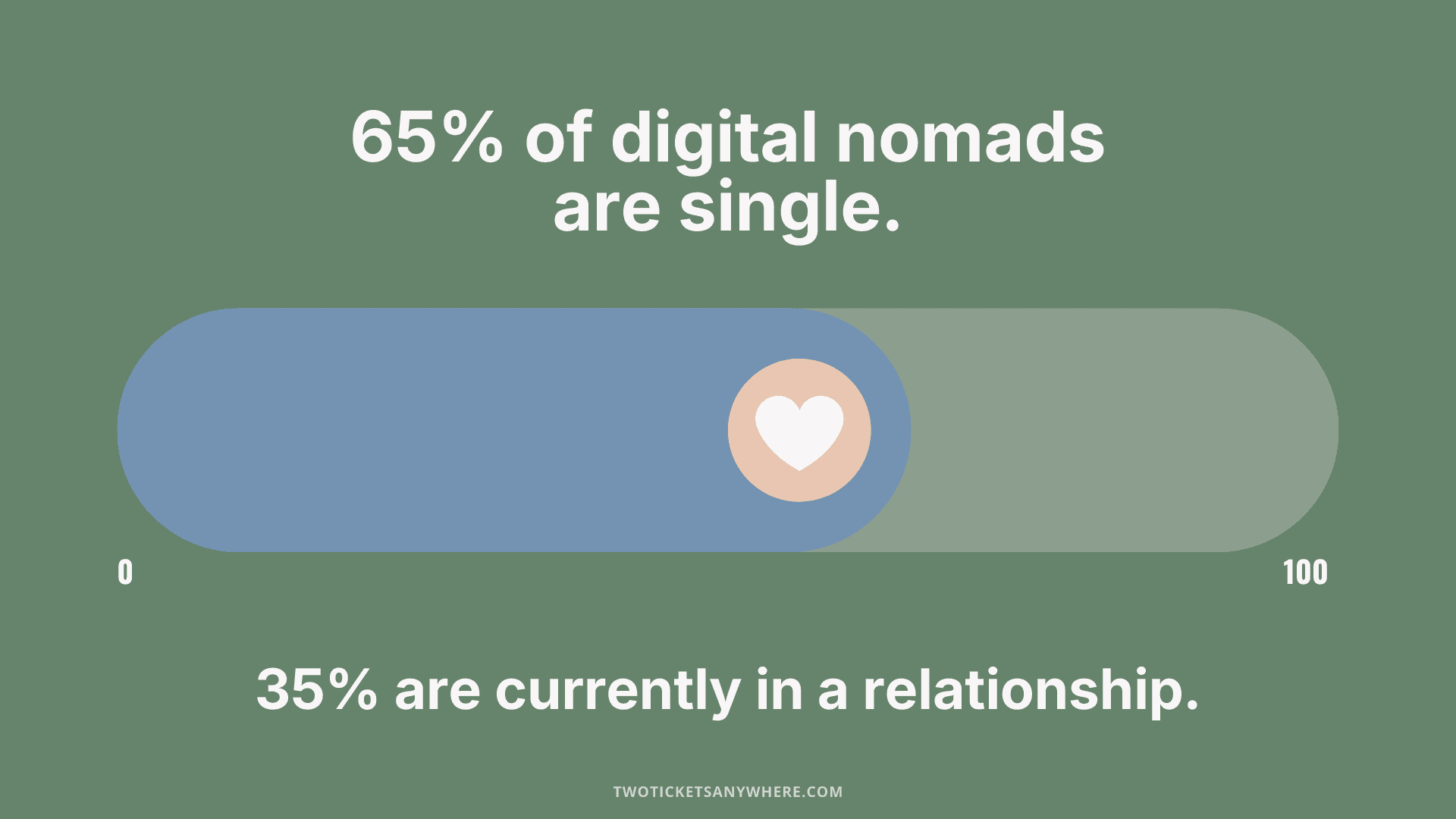
Of those people who are in a relationship, 54% of them are married and 46% are unmarried. This is an interesting contrast because the general view amongst nomads is that most people don’t get married.
What’s more?
Only 31% of married digital nomads travel with their partners full-time.
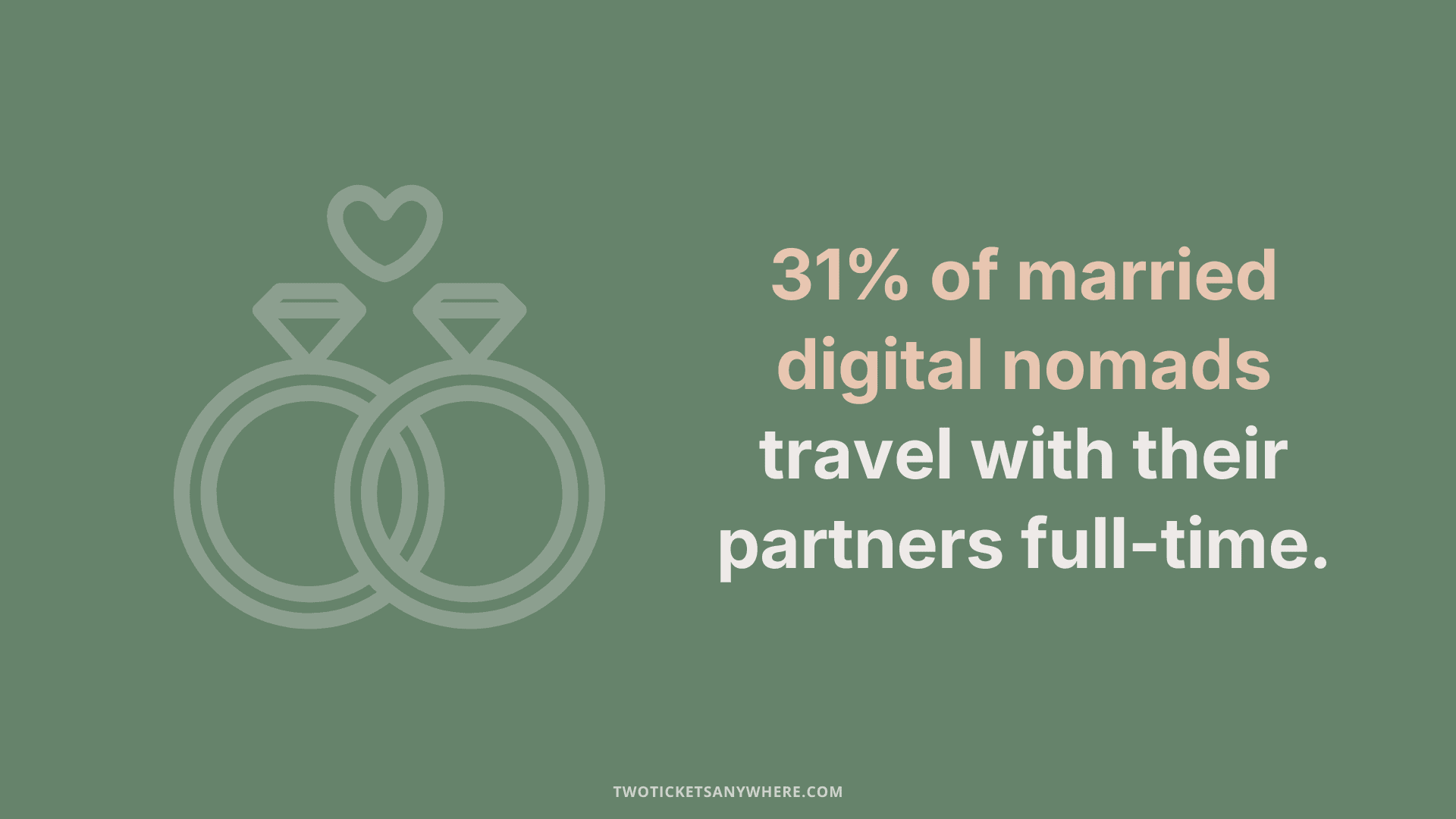
38% travel with them part-time and a significant 32% of married digital nomads don’t travel with their partners at all.
Do Digital Nomads Have Children?
Only 26% of digital nomads in a relationship have children under the age of 18.
Clearly, the digital nomad lifestyle is more suited to people who are single or in a relationship but don’t yet have families. But that doesn’t mean it’s not possible.
There is a growing trend for digital nomad families to pack up and hit the road with their children. Nomad parents want to give their children more opportunities to learn about new cultures and see the world from a different perspective. Personally, I love this idea!
My parents took my brother and I out of school for a year in 2004 (I was 10 years old) and we did a world trip. This was my first time out of Australia, and it had a significant, positive impact on my life.
But this idea hasn’t taken hold in every parent. Only 41% of children travel with their digital nomad parents full-time. That means 59% of children travel part-time with their parents or not at all.
This is likely due to education.
It’s difficult for parents to home-school their children, so it’s often easier to enrol them in a traditional school while the parents travel.
What Are Digital Nomads Looking for in Relationships?
35% of digital nomads are just looking for friends, and 32% are looking travel buddies.
Here are the latest digital nomads statistics about what nomads are actually looking for:
| Looking For | Percentage (%) |
|---|---|
| Friends | 35% |
| Travel Buddies | 32% |
| Casual Dating | 15% |
| Relationships | 13% |
| Poly Dating | 4% |
Source: Nomads.com
That means 2/3 of digital nomads aren’t looking for dating relationships at all!
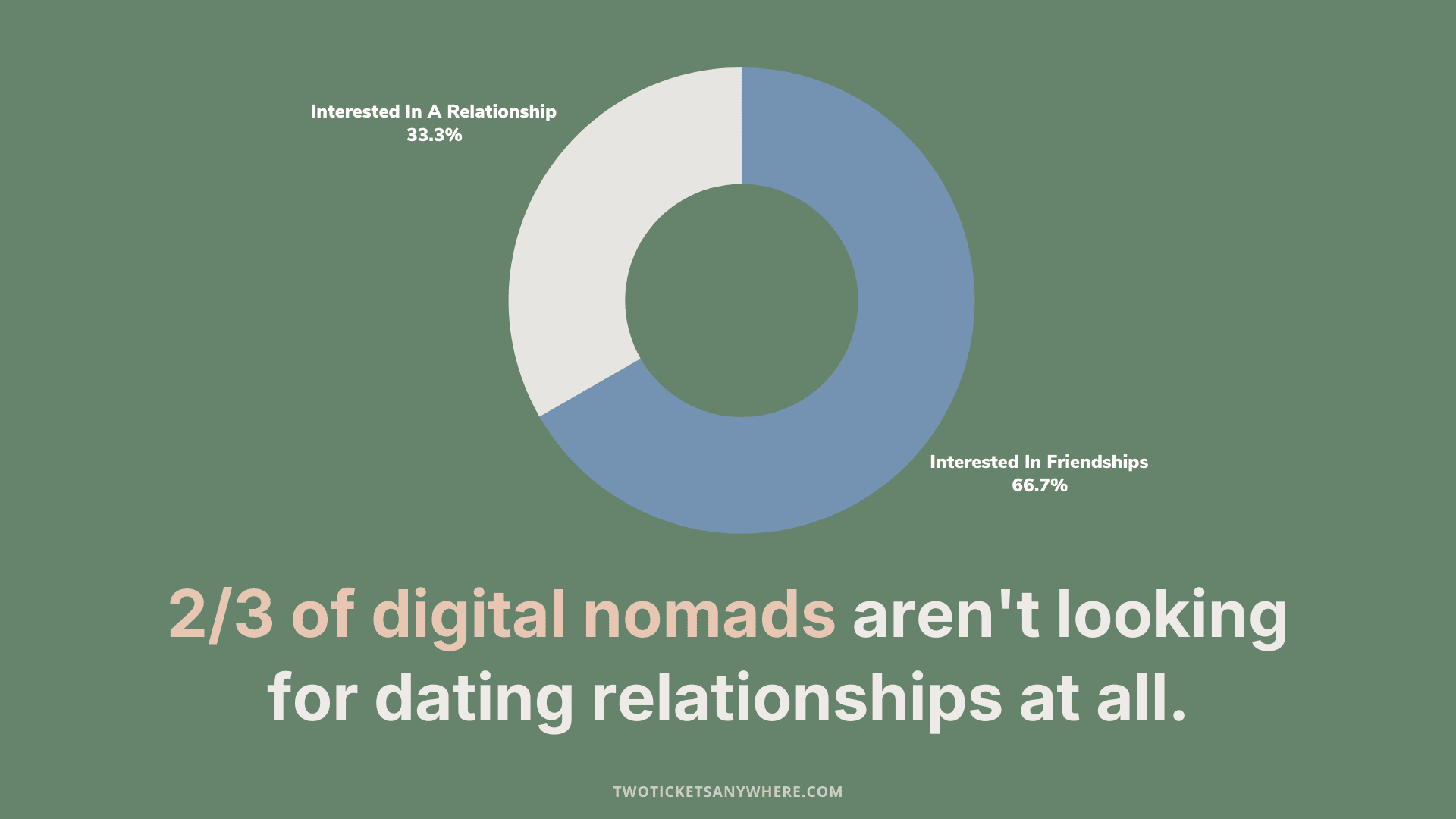
15% of digital nomads are looking for casual relationships at the moment. 13% are looking for more long-term relationships.
There is no doubt that dating is difficult as a digital nomad.
Most digital nomads spend only shorter periods in each location. This makes it hard not only to meet someone but also spend enough time to get to know each other.
Education And Training Statistics
54% of digital nomads have some form of formal education, holding a college degree or higher.
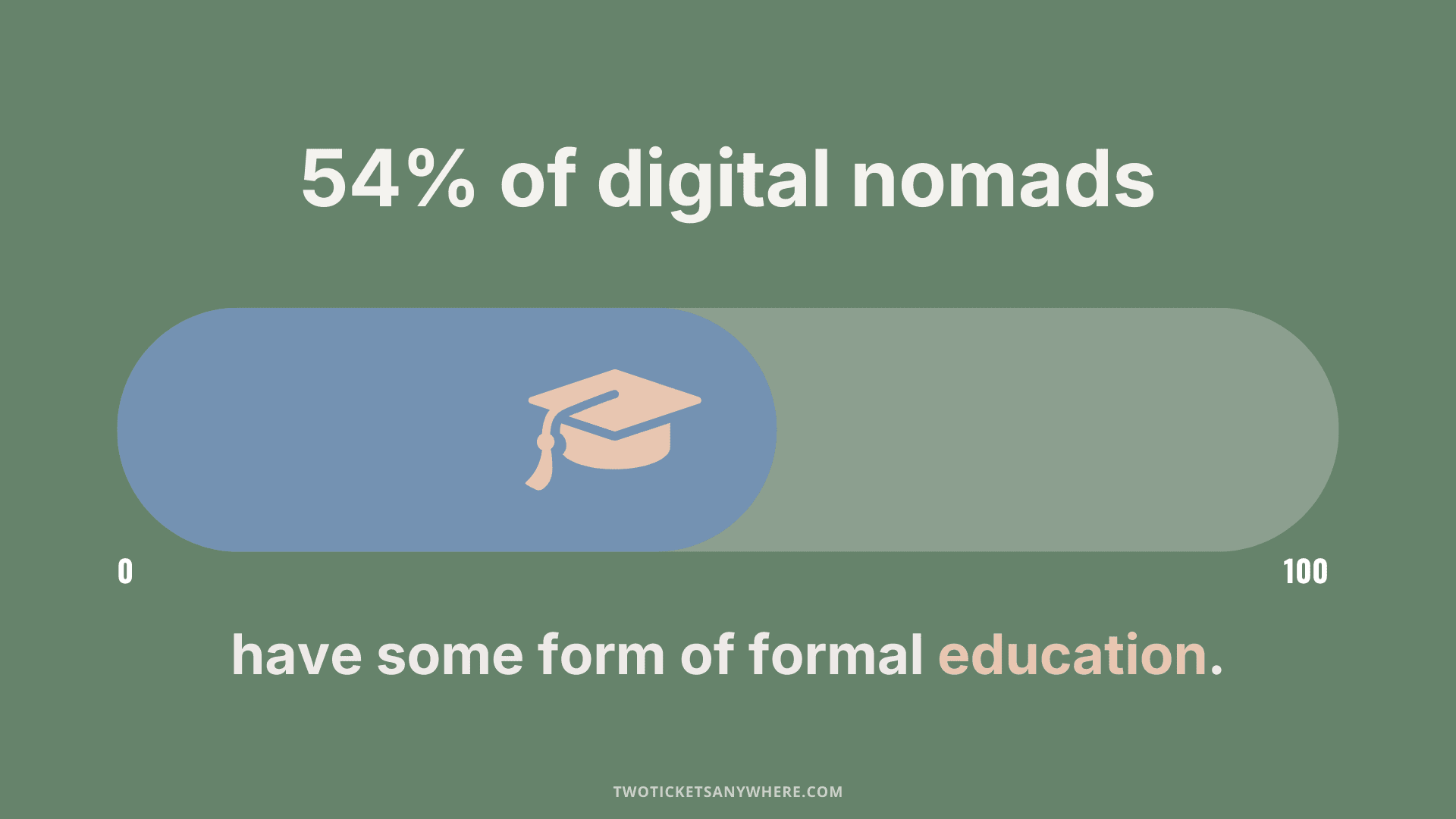
In fact, most digital nomads complete their degrees and then do a few years in the corporate world before becoming digital nomads.
Here is the formal education that digital nomads have:
| Highest Level Of Education | Percentage Of Digital Nomads (%) |
|---|---|
| High School | 46% |
| Bachelor’s | 35% |
| Master’s | 16% |
| PhD | 3% |
Source: MBO Partners, Nomads.com; Collated by TwoTicketsAnywhere.
A bachelor’s degree is the most popular form of formal education, with 54% of all digital nomads possessing one. Even a Master’s is not uncommon, with 19% of all nomads obtaining their Master’s.
PhDs are far less common, with just 3% of all nomads spending the time to get one.
What about high school?
46% of digital nomads completed their high-school diploma and did not pursue any other form of education.
The bottom line: The vast majority of digital nomads are college-educated.
Digital Nomad Jobs & Careers
The number of jobs you can now do remotely is amazing.
And digital nomads are the best at finding ways to take their work remote. These are the latest digital nomad statistics on jobs and careers.
Employed vs Self-Employed
Most people think that digital nomads are self-employed with remote jobs.
But that couldn’t be further from the truth. Here’s what it looks like:
| Work | Percentage |
|---|---|
| Employed | 61% |
| Self-Employed | 39% |
Source: MBO Partners
This is a big jump in recent years.
Now, 61% of all digital nomads are employed in a remote work position, and 39% are self-employed.
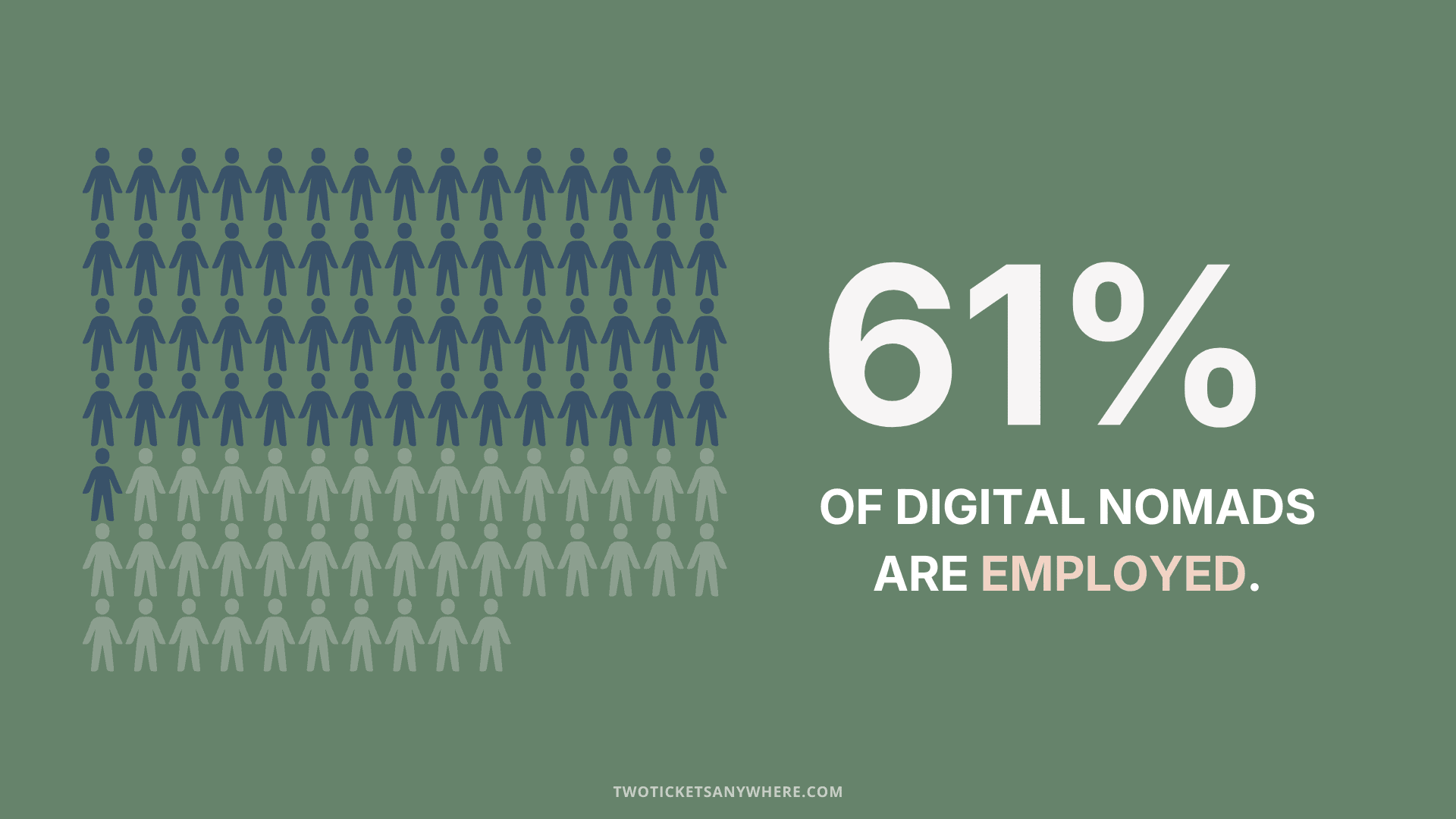
The truth is that lots of nomads join the digital nomad lifestyle to have the freedom to work on what they want. Nomads tend to be people who are passionate about what they do and put their hearts and souls into their work.
Self-employed digital nomads aren’t just freelancers either…
52% of self-employed digital nomads are freelancers/contractors and 48% are business owners.
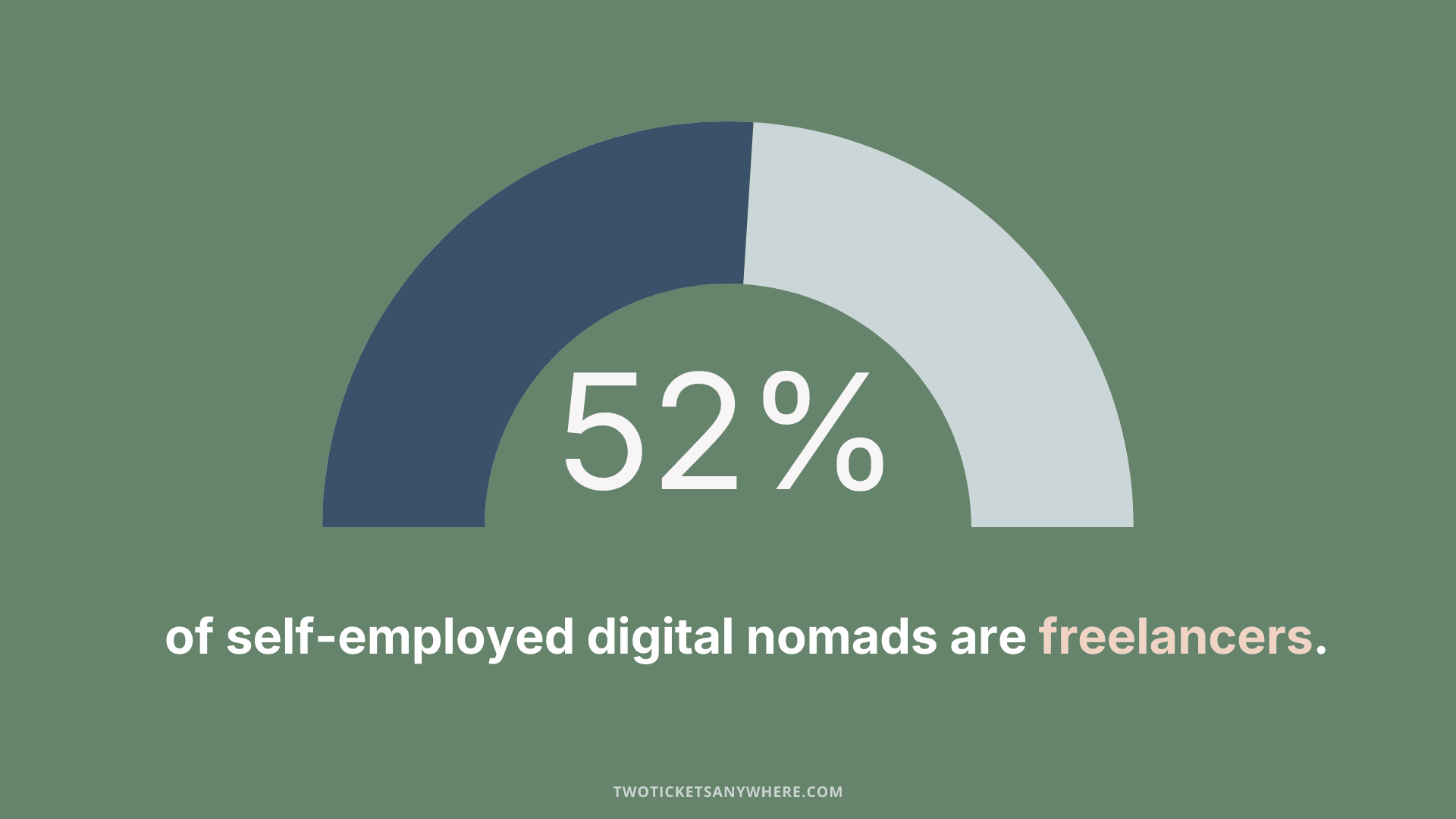
That’s almost a 50/50 split between self-employed digital nomads.
Becoming a freelancer is a popular option because you get the flexibility of working for yourself without the stricter policies of being a full-time employee at a company.
As we’ve traveled, we notice a common path amongst digital nomads.
They start out as either freelancer or employees and start their businesses while traveling.
Top Digital Nomad Industries
What kinds of digital nomad jobs do people do?
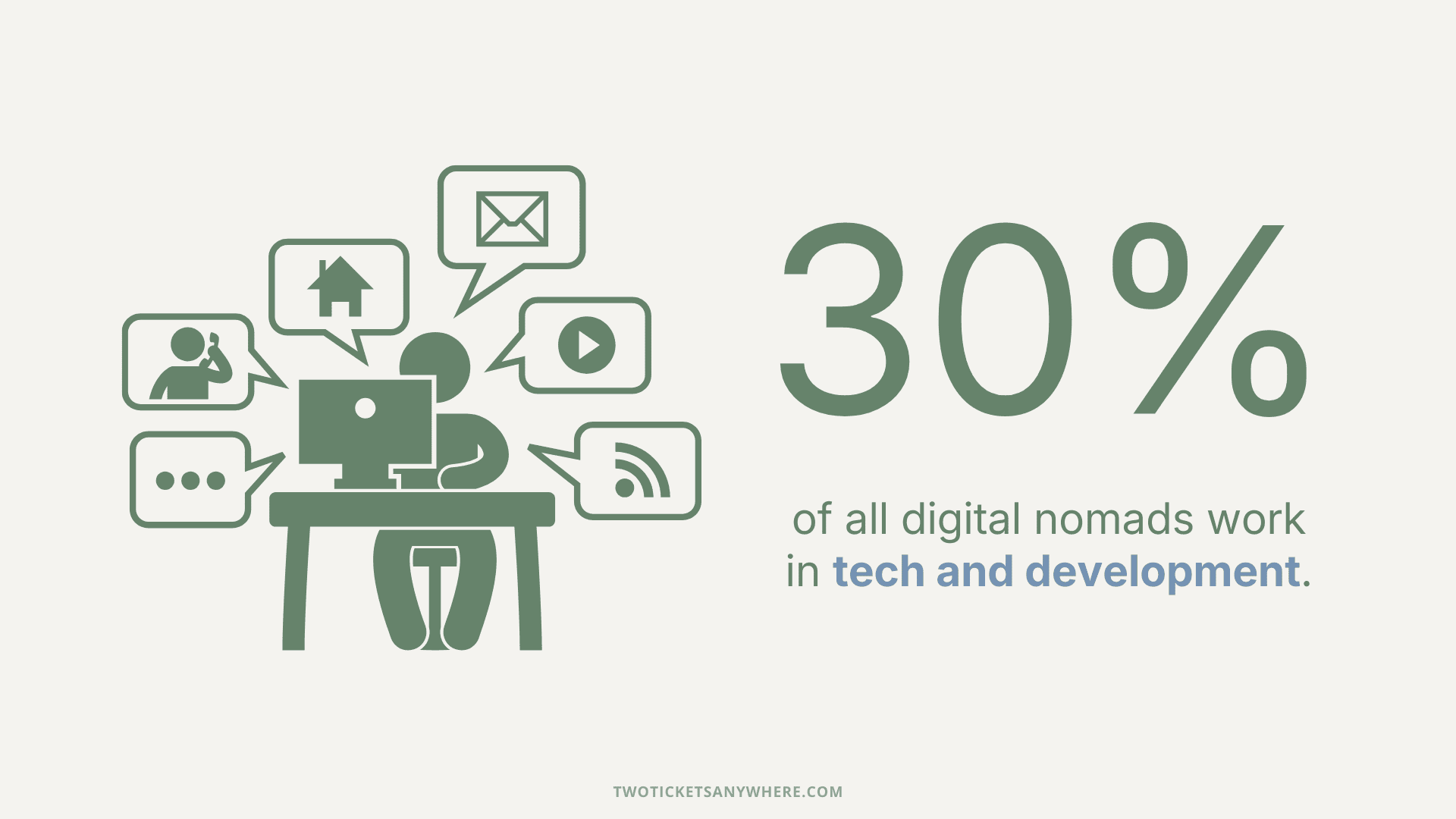
Most digital nomads work in tech, marketing, creative, and professional service roles. Software development and digital marketing are the clear leaders.
| Industry | Included Roles | % of Digital Nomads |
|---|---|---|
| Tech & Development | Software Dev, Web Dev, Mobile Dev, Data | 29% |
| Marketing & Growth | Marketing, Sales | 15% |
| Creative & Content | Creative, UI/UX Design, Blogging | 14% |
| Entrepreneurship & Startups | Startup Founder, SaaS | 14% |
| Product & Operations | Product Manager, Community | 9% |
| Education & Coaching | Education, Coaching | 7% |
| Finance & Crypto | Finance, Crypto | 7% |
| E-commerce | E-commerce | 6% |
Source: Nomads.com; Percentage data is based on collated individual role categories across both men and women by TwoTicketsAnywhere.
There is quite a big difference between men and women when it comes to jobs that nomads do remotely.
These are the top 5 for men:
- Software Developer – 35%
- Web Developer – 28%
- Startup Founder – 28%
- Marketing – 15%
- SaaS / Tech Founder – 14%
Development is undoubtedly the primary industry for men. Marketing and creative are also popular industries for men to be involved in.
What about women?
These are the top 5 jobs for Women:
- Marketing – 15%
- Creative (Design, Writing, Media) – 15%
- Startup Founder – 11%
- Software Developer – 9%
- UI/UX Designer – 8%
What’s interesting about these digital nomad statistics is that men are far more likely to work in tech and development roles. Women are more evenly distributed across marketing, creative, and entrepreneurial jobs.
When combining the data for men and women, we see that tech development, marketing and creative are the most popular industries as a whole.
Based on collated role data, tech and development jobs account for roughly three in ten digital nomads, making it the most common industry, followed closely by marketing and creative roles.
What Are The Top Digital Nomad Destinations
There are tons of great digital nomad destinations around the world.
Here are the digital nomad stats on the top countries and cities for digital nomads.
Popular Digital Nomad Countries
The top 10 most popular countries for digital nomads are:
| Country | Visited By Digital Nomads |
|---|---|
| 🇺🇸 United States | 14% |
| 🇹🇭 Thailand | 5% |
| 🇪🇸 Spain | 5% |
| 🇩🇪 Germany | 4% |
| 🇬🇧 United Kingdom | 4% |
| 🇲🇽 Mexico | 3% |
| 🇫🇷 France | 3% |
| 🇮🇹 Italy | 3% |
| 🇵🇹 Portugal | 3% |
| 🇮🇩 Indonesia | 2% |
Source: Nomads.com
The United States tops the list, mostly due to the fact that US Nomads return home and spend a bit of time there. Then, Europe, notably Spain, Germany and the UK are popular countries as well.
South East Asia has always been a popular place for digital nomads, with Thailand and Indonesia clear stand outs.
Throughout 2020 and 2021, Mexico exploded as a popular digital nomad country and still is today. There are tons of great cities, such as Playa del Carmen and hidden digital nomad gems like San Cristobal de las Casas.
The truth is the whole of Latin America has become very popular for digital nomads – including Medellin and Antigua Guatemala.
Portugal has also become a popular digital nomad country post-pandemic. Lisbon is the most popular city due to the lower cost of living (for Europe) and its beautiful aesthetic.
Interestingly, 9 out of 10 (90%) digital nomads said they prefer to live in the coastal countries of the world.
Popular Digital Nomad Cities
What’s interesting is that the most popular cities don’t necessarily line up with the top countries.
The top 10 most popular digital nomad cities are:
| City | Visited By Digital Nomads |
|---|---|
| 🇬🇧 London | 2.19% |
| 🇹🇭 Bangkok | 2.19% |
| 🇺🇸 New York City | 1.50% |
| 🇪🇸 Barcelona | 1.49% |
| 🇫🇷 Paris | 1.47% |
| 🇩🇪 Berlin | 1.46% |
| 🇵🇹 Lisbon | 1.44% |
| 🇳🇱 Amsterdam | 1.20% |
| 🇺🇸 San Francisco | 1.15% |
| 🇹🇭 Chiang Mai | 1.08% |
Source: Nomads.com
Chiang Mai, Bali and Lisbon are basically the OGs of digital nomad cities. Barcelona and Amsterdam have become more recent trendy digital nomad hotspots.
Most Liked Digital Nomad Countries
There are a lot of places you’ll go to once…and once is enough.
But what countries do digital nomads absolutely love?
These are the top 10 most liked countries by digital nomads:
| Country | Rating (Out of 5) |
|---|---|
| 🇯🇵 Japan | 4.8 |
| 🇭🇷 Croatia | 4.6 |
| 🇭🇺 Hungary | 4.55 |
| 🇨🇿 Czechia | 4.55 |
| 🇱🇻 Latvia | 4.5 |
| 🇵🇱 Poland | 4.4 |
| 🇰🇷 South Korea | 4.4 |
| 🇨🇭 Switzerland | 4.35 |
| 🇬🇷 Greece | 4.3 |
| 🇿🇦 South Africa | 4.25 |
Source: Nomads.com
What’s interesting is that the most liked countries often differ significantly from the most popular countries for nomads.
Average Cost Of Living
Here’s the truth:
Traveling full-time as digital nomads isn’t cheap. But it also doesn’t have to be expensive either.
37% of nomads said they became digital nomads because they wanted to avoid the high cost of living in their home country.
There are so many locations that digital nomads visit throughout the year that the cost of living differs a lot. This makes it hard to nail down an average because each place changes.
We’ve been traveling as full time digital nomads since 2018. These next digital nomad statistics about the cost of living are based on our average monthly living expenses.
This is our average cost of living as digital nomads over the last 12 months:
| Category | COST ($USD) |
|---|---|
| Accommodation | $1,341 |
| Groceries | $436 |
| Dining Out | $485 |
| Transport | $216 |
| Phone Plan | $26 |
| Activities & Entertainment | $158 |
| Gym Memberships | $96 |
Source: TwoTicketsAnywhere.
The average monthly cost of living as digital nomads is $2,758 USD.
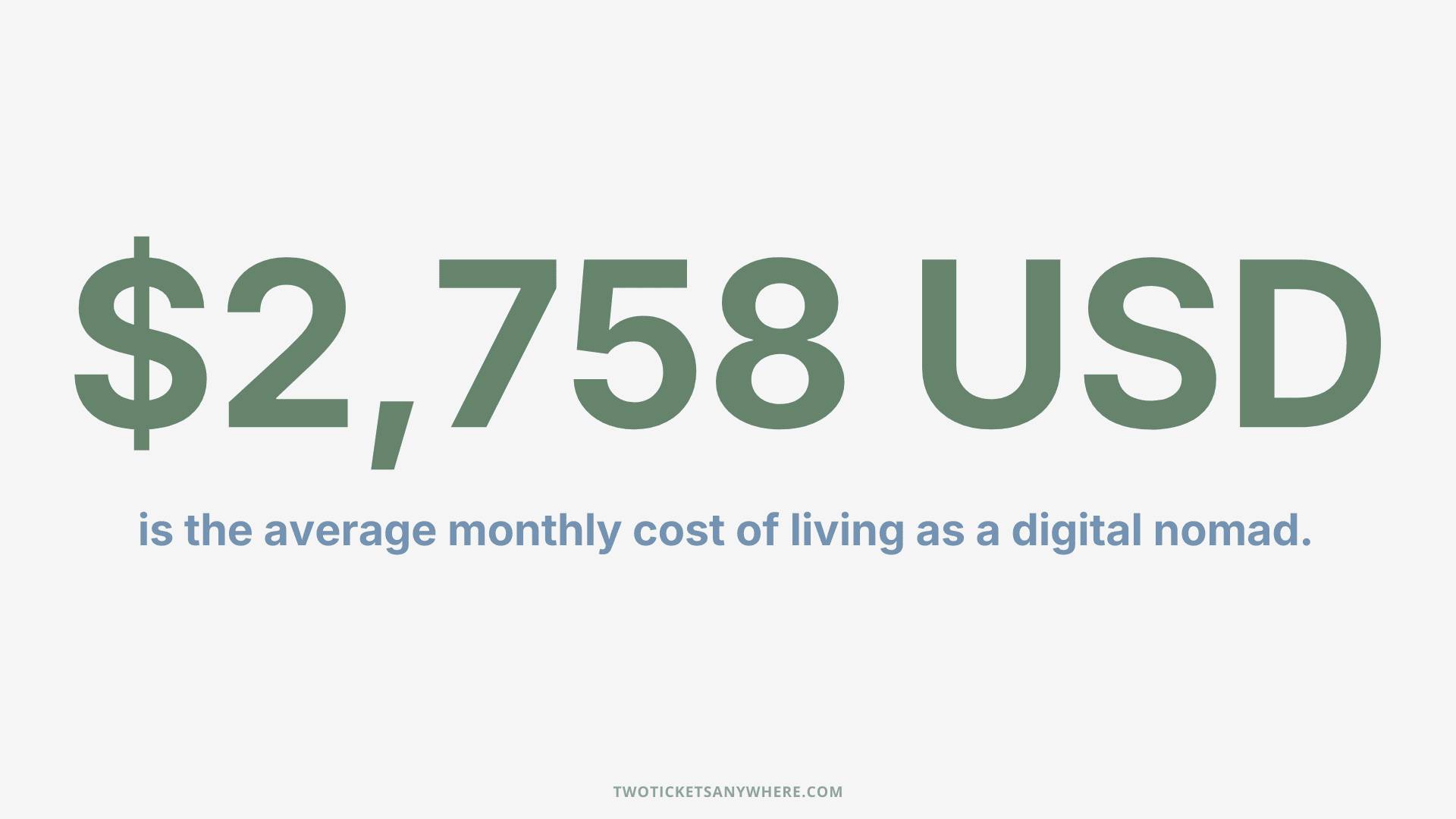
Remember: This is average and for a couple. Single nomads will have a cheaper cost of living – usually by about 30%.
Some places are more expensive while others are cheaper. This also doesn’t include the cost of flights throughout the year.
We spend about $3,468 USD each (total $6,936) on flights per year. This works out to be about $289 USD each per month that we need to budget for flights. Despite what you have been told…
International travel is expensive, and travel expenses do add up quickly. But compare that to living in a country like Australia, the United States or many Western European countries, it’s often cheaper to live as a Nomad.
2 other important categories for us are-
- Coworking
- Travel Insurance / Health insurance
We take Coworking in most places we stay in the world and the average coworking space costs about $120 USD per month.
For digital nomad insurance, the top two companies are SafetyWing and Genki. Depending on age, most nomads spend an average $60 per month on travel insurance or $220 if they opt for international health insurance.
Do Digital Nomads Budget?
We ran a survey on a couple of popular Facebook groups to find out how much digital nomads budget.
Here’s what we found:
| Budget | Percentage (%) |
|---|---|
| Yes | 46% |
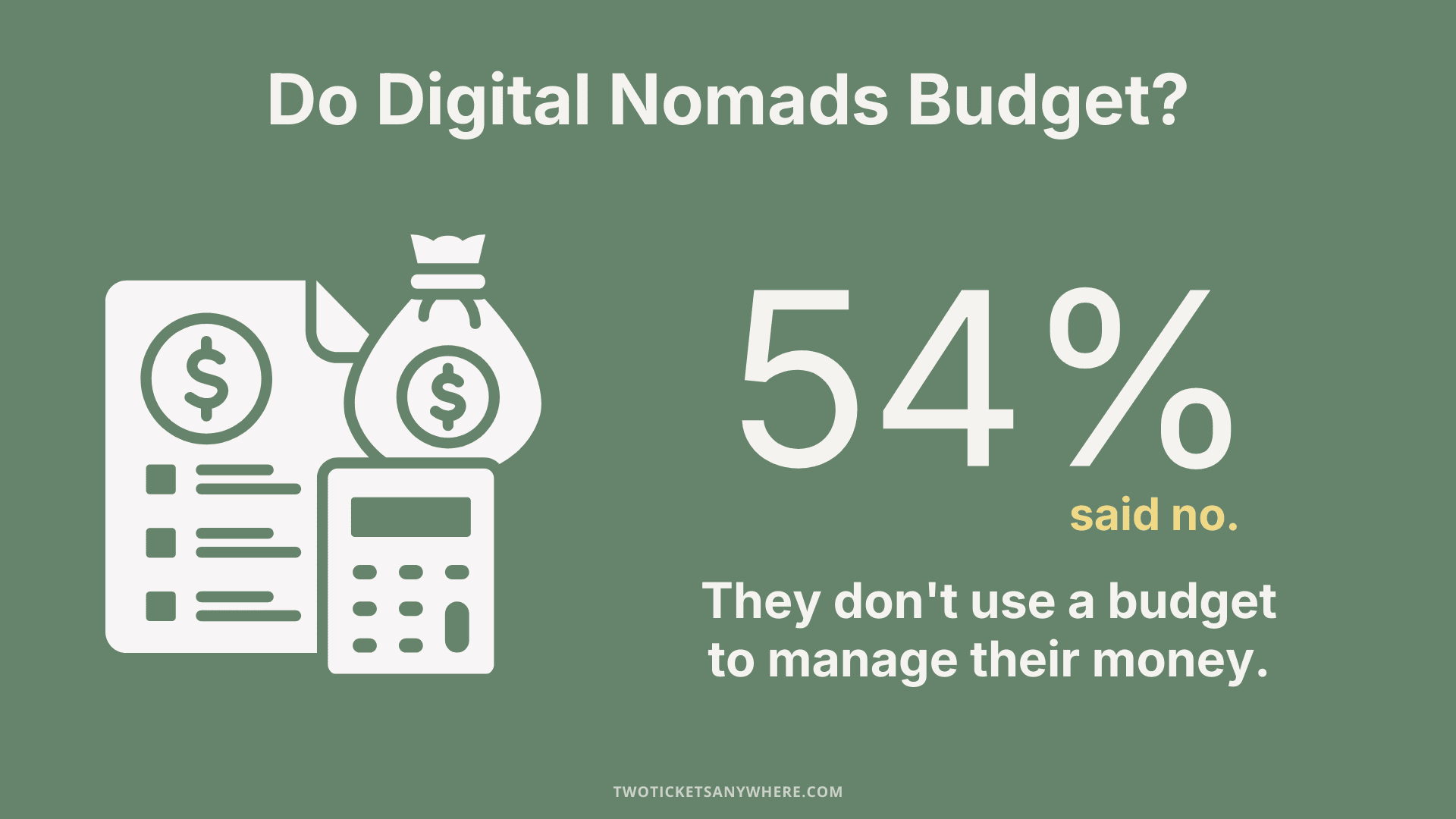
| No | 54% |
Source: TwoTicketsAnywhere.
The majority of digital nomads don’t use a budget at all.
54% of digital nomads don’t use a budget to manage their money.
27% of respondents said they use a custom Excel spreadsheet or Google sheet to track their spending. 19% of digital nomads use an application to track all of their costs. We use a digital nomad app to budget called TravelSpend.
How Long Do Digital Nomads Stay In One Place?
Originally digital nomads used to fast travel through countries to visit as many countries as possible.
For some people, the lifestyle was almost like a checklist of trophies to post on Instagram. But as the digital nomad movement has grown, it has evolved (thankfully).
Today most digital nomads prefer to slow travel, staying in locations for 1+ months and really experiencing the place for what it is.
This is how long most digital nomads spend in a single country:
| Duration In One Country | Percentage Of Nomads |
|---|---|
| Less Than 7 Days | 0% |
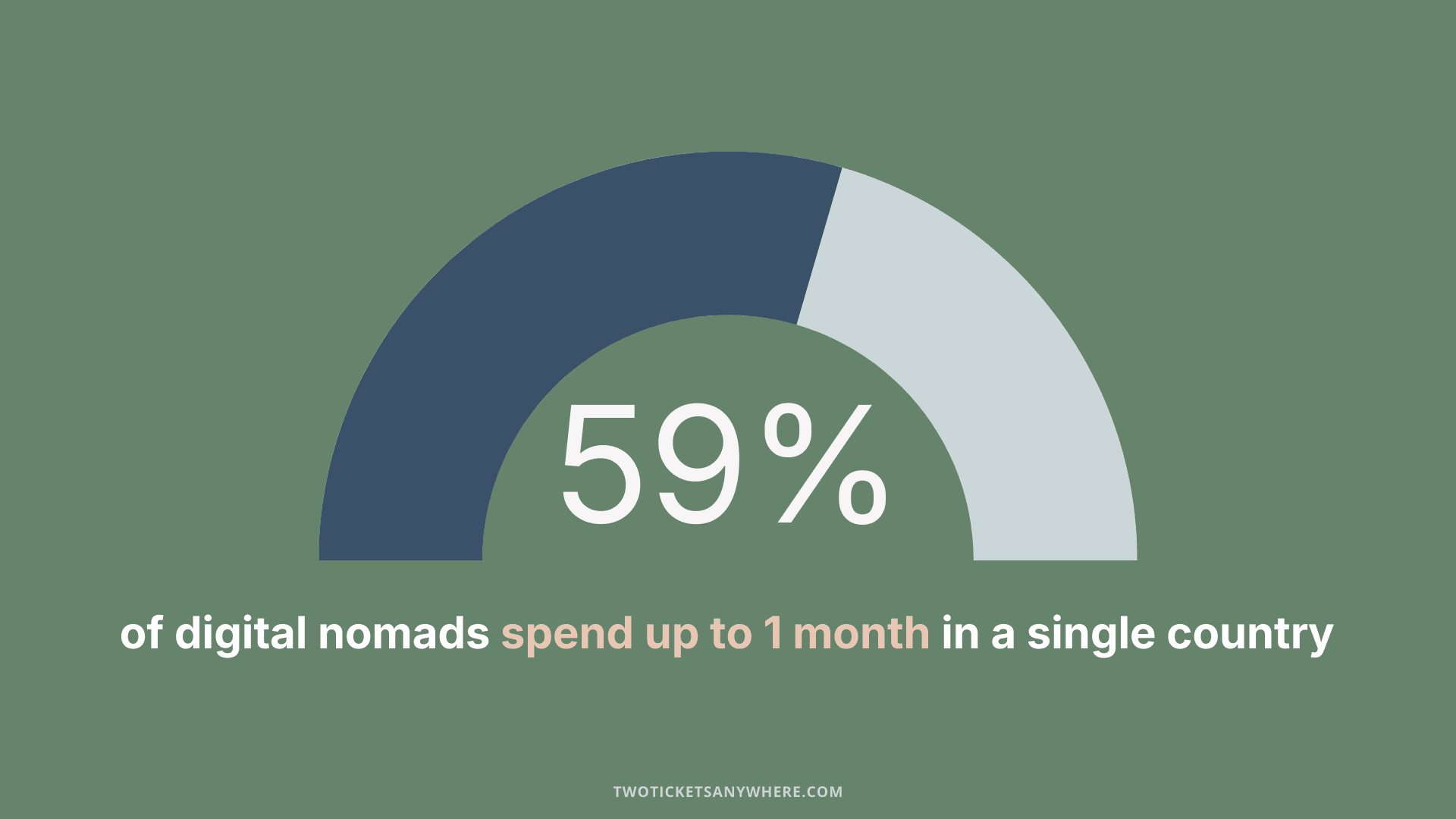
| 7 – 30 Days | 59% |
| 30 – 90 Days | 28% |
| 90+ Days | 14% |
Source: Nomads.com
There has undoubtedly been a significant shift to slower travel.
It’s become much more balanced than it used to be, with 59% spending up to 1 month in a single country.
Interestingly there is a growing movement of long-term stay nomads, with 47% of digital nomads spending more than 90+ days in a digital nomad destination. These kinds of digital nomads are called slow-mads.
More than 1/3 of digital nomads stay for over 1+ month in a single destination. Fast travel as a digital nomad isn’t sustainable for most people.
At some point, you have to do work, right?
But what I find interesting is that while digital nomads spend longer periods of time in a single country, they often fast-travel within the country.
This is how long nomads stay in one city on average:
| Duration In One Country | Percentage Of Nomads |
|---|---|
| Less Than 7 Days | 47% |
| 7 – 30 Days | 33% |
| 30 – 90 Days | 14% |
| 90+ Days | 16% |
Source: Nomads.com
Compare the less than 7-day statistic. Essential 0% of nomads spend less than 7 days in a country, while 47% will spend less than 7 days in a city.
So clearly, digital nomads do travel relatively fast still, they just don’t change countries as frequently. From experience, it’s less taxing on your body and mind to travel in a country domestically vs changing countries internationally.
But just because nomads visit lots of locations throughout the year doesn’t mean they actually change countries all that often.
So how many countries do digital nomads visit each year?
| Number Of Countries Per Year | Percentage (%) |
|---|---|
| 1 to 3 | 73% |
| 4 to 7 | 19% |
| More Than 8+ | 8% |
Source: Twoticketsanywhere
A huge 73% of digital nomads visit just 1-3 countries per year outside of their home country.
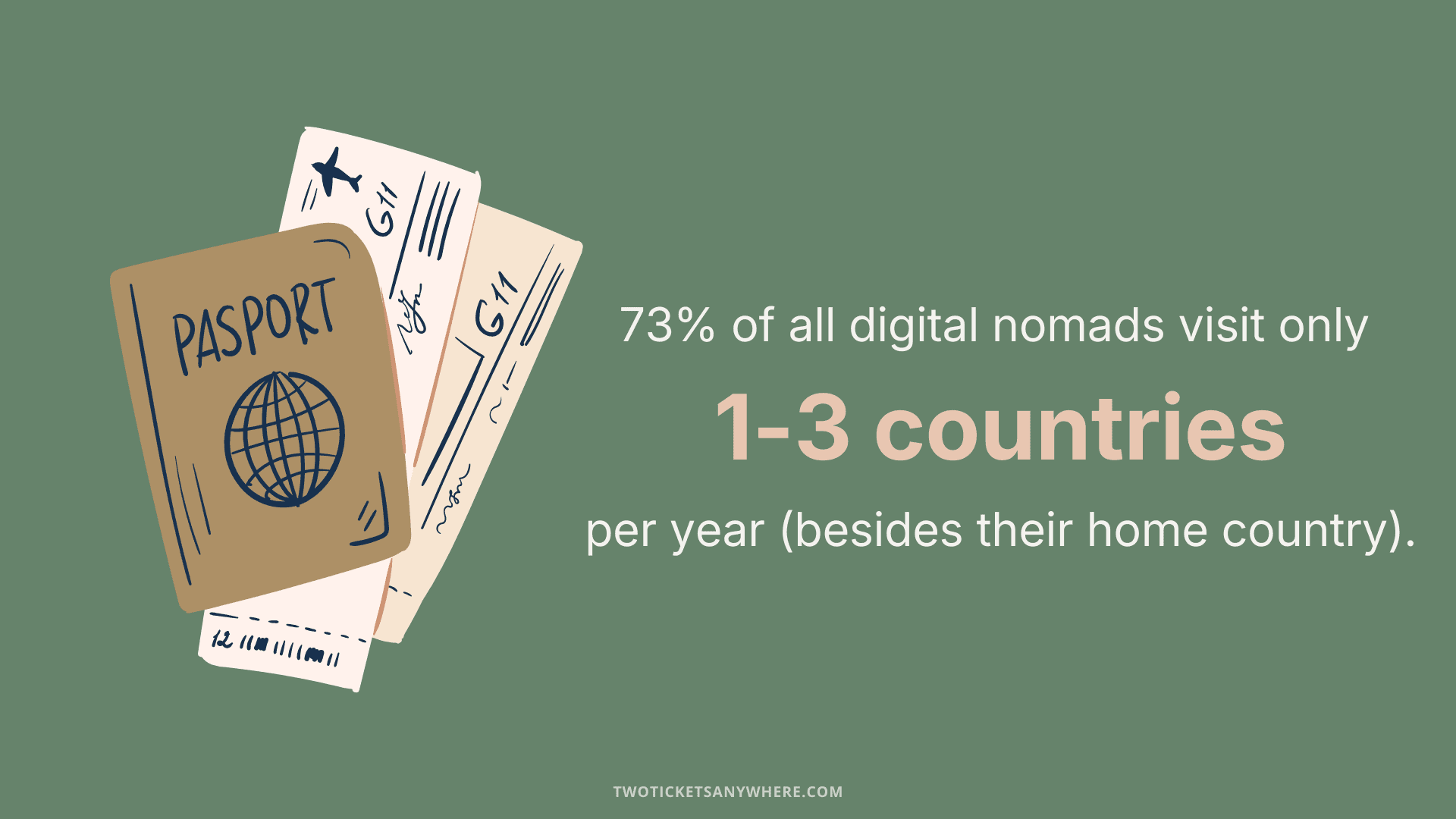
19% visit 4-7 countries and a small 8% visit more than 8+ countries. We personally fit into the 8+ country category and wouldn’t change it for the world.
What parts of the world are most digital nomads traveling?
| Region | Share Of Visits (%) |
|---|---|
| Europe | 29% |
| Americas | 23% |
| Asia | 15% |
| Rest of World | 33% |
Digital nomads in Latin America enjoyed fewer restrictions throughout the COVID-19 pandemic, making it a huge hotspot. Latin America is also a more accessible place to travel for US and European residents who make up the majority of digital nomads.
Latin American countries also tend to offer longer-term visas for many passports. For example:
- Mexico offers up to a 180-day tourist visa on arrival
- Colombia offers 90 days with the ability to extend for another 90 days
- Guatemala also has the 90 days tourist visa with the opportunity to extend
This means that digital nomads can spend a longer time within these countries without worrying about their visas.
Where Do Digital Nomads Live And Work?
Depending on the speed at which digital nomads travel often determines the accommodation they use.
Accommodation For Digital Nomads
The most popular accommodations for digital nomads are:
- Airbnb
- Hostels
- Coliving Spaces
- Hotels
Airbnb reported that they were seeing more long-term stays on the platform. 20% of all Airbnb’s booked were for a month or longer.
The search for “laptop-friendly workspaces” also increased by a huge 73% amongst longer stays.
We conducted our own poll to find out where digital nomads like to stay. These are the results:
| Accommodation Type | Percentage Of Digital Nomads |
|---|---|
| Airbnb | 44% |
| Hostel | 37% |
| Coliving | 16% |
| Hotel | 2% |
| Other | 1% |
Airbnb is clearly the most popular accommodation type, with 44% of digital nomads using Airbnb.
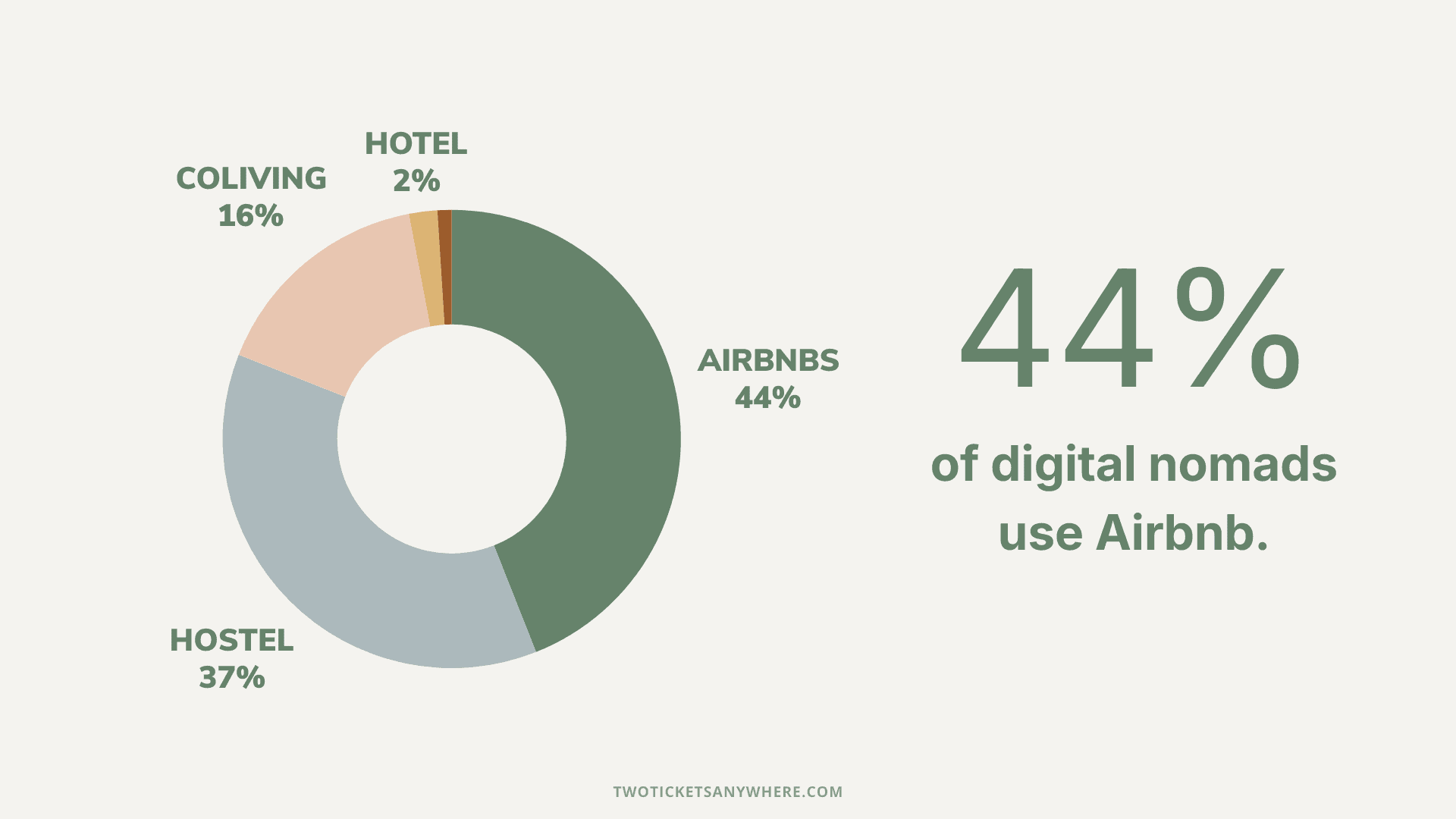
Hostels are also a very popular type of accommodation with 33% of digital nomads regularly using them. Coliving spaces are also growing with 16% of digital nomads taking advantage of coliving. The biggest benefit to coliving spaces is that you usually get community combined with a workspace and decent apartments/living spaces.
That’s why coliving is growing amongst nomads.
Places For Digital Nomads To Work
When it comes to working digital nomads have 3 primary options:
- Apartment/Hostel
- Cafes
- Coworking spaces
The numbers a different from what you might think:
| Place To Work | Percentage (%) |
|---|---|
| Apartment/Hostel | 46% |
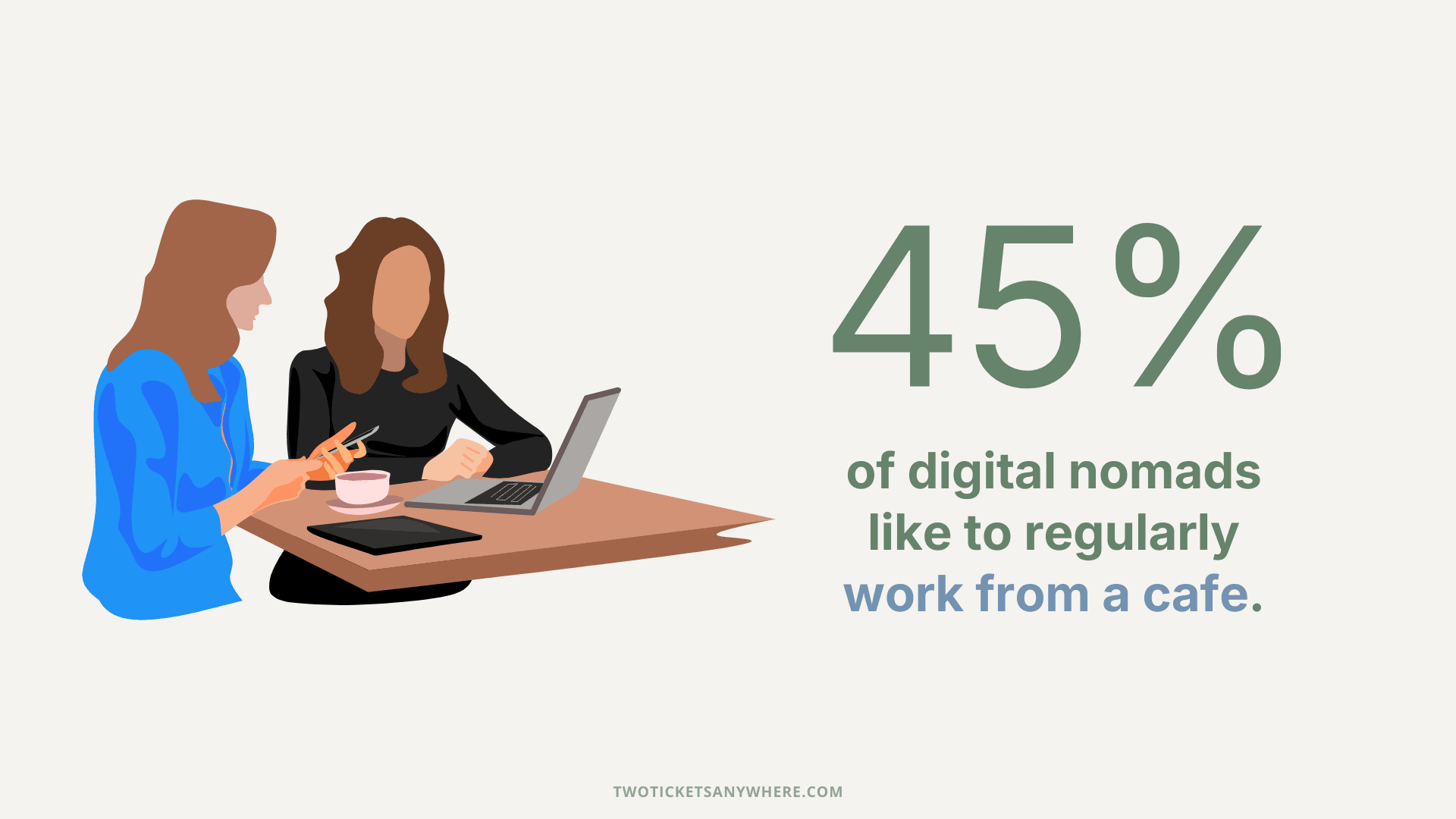
| Cafes | 45% |
| Airbnb | 27% |
| Coworking Spaces | 19% |
The majority of digital nomads choose to work from their accommodation (Airbnbs, apartments, hostels).
This makes sense to some degree. Most hostels have common spaces with tables and chairs where you can get work done. And as we already saw, Airbnb has seen a 73% increase for apartments with laptop-friendly workspaces amongst long stays.
45% of digital nomads also said they like regularly working from cafes.
The cafe work culture has become a trend on its own. But what about coworking spaces?
Coworking spaces have been around for a long time and ranked lowest for digital nomads. Only 19% of digital nomads said they regularly choose to work in a coworking space.
We fit into this category but totally understand it’s not everyone’s slice of toast. It also depends hugely on the quality of the coworking space and what’s included in the deal.
Still, approximately 1.93 million people around the world use coworking spaces today. That number has increased steadily over the last few years – especially amongst digital nomads.
The biggest reason to join a coworking space was to find a digital nomad community.
Digital Nomad Visas
Digital nomad visas are a controversial topic.
Why?
Because most digital nomad visas are long-term often 1-2 years. When you stay in a country for more than a year are you really a digital nomad or an expat?
I’ll let you decide.
But there is no doubt that digital nomad visas are a trend. There are now 41 countries that offer digital nomad visas (in some form) worldwide.
These are the latest digital nomad statistics on visas.
What Countries Offer Digital Nomad Visas?
These are all the countries that offer digital nomad visas at the moment.
| Country | Visa Length |
|---|---|
| 🇦🇬 Antigua and Barbuda | Up to 2 years |
| 🇦🇮 Anguilla | 12 months |
| 🇦🇷 Argentina | 12 months |
| 🇦🇼 Aruba | 12 months |
| 🇧🇧 Barbados | 12 months |
| 🇧🇸 Bahamas | 12 months |
| 🇧🇿 Belize | 6–12 months |
| 🇧🇲 Bermuda | 12 months |
| 🇧🇷 Brazil | 12 months |
| 🇨🇻 Cabo Verde | 6–12 months |
| 🇰🇾 Cayman Islands | Up to 2 years |
| 🇨🇴 Colombia | 12 months |
| 🇨🇷 Costa Rica | 12 months (renewable once) |
| 🇭🇷 Croatia | 12 months |
| 🇨🇾 Cyprus | 12 months |
| 🇨🇿 Czech Republic | 12 months |
| 🇩🇲 Dominica | 18 months |
| 🇪🇪 Estonia | 12 months |
| 🇪🇸 Spain | 24 months (renewable) |
| 🇬🇪 Georgia | 12 months |
| 🇬🇷 Greece | 12 months |
| 🇭🇺 Hungary | 12–24 months |
| 🇮🇸 Iceland | 6 months |
| 🇮🇹 Italy | 12 months |
| 🇯🇵 Japan | 6 months |
| 🇱🇻 Latvia | 12 months |
| 🇲🇾 Malaysia | 12 months |
| 🇲🇹 Malta | 12 months |
| 🇲🇺 Mauritius | 12 months |
| 🇲🇽 Mexico | 12 months (renewable up to 4 years) |
| 🇲🇪 Montenegro | 12 months |
| 🇳🇴 Norway | Up to 2 years |
| 🇵🇦 Panama | 9 months (renewable once) |
| 🇵🇹 Portugal | 12 months (renewable) |
| 🇷🇴 Romania | 12 months |
| 🇸🇮 Slovenia | 12 months |
| 🇰🇷 South Korea | 6–12 months |
| 🇹🇭 Thailand | Long-term (up to 10 years, LTR) |
| 🇹🇷 Turkey | 12 months |
| 🇦🇪 United Arab Emirates | 12 months |
| 🇹🇼 Taiwan | 6 months |
Of the 41 countries worldwide that currently offer a digital nomad or remote-work visa, around 45% are located in Europe.
Approximately a dozen of these European options are part of the Schengen Area, making Europe particularly attractive for nomads looking to move freely between countries.
This is attractive to those who want to travel around the Schengen countries for longer than 90 days.
But most of these visas come with some travel restrictions on how long you must spend in the country. You also have monthly or yearly income requirements for most digital nomad visas.
This makes sense because they don’t want backpackers trying to do it cheaply.
The goal is to get you to spend money.
Biggest Challenges For Digital Nomads
While the digital nomad lifestyle may look glamorous on the outside, not everything is perfect.
Digital nomads face a unique set of challenges that come with the lifestyle. The truth is that digital nomadism isn’t for everyone.
The biggest challenges for digital nomads are:
| Challenge | Percentage (%) |
|---|---|
| Financial Stress | 24% |
| Personal Safety | 25% |
| Being away from family and friends | 26% |
| Time zone issues | 21% |
| Managing work and travel | 21% |
| Loneliness | 18% |
| Travel Logistics | 20% |
If you know anything about digital nomads, you’ll know that wifi comes up as a topic a lot. It’s the same as people always talking about the weather.
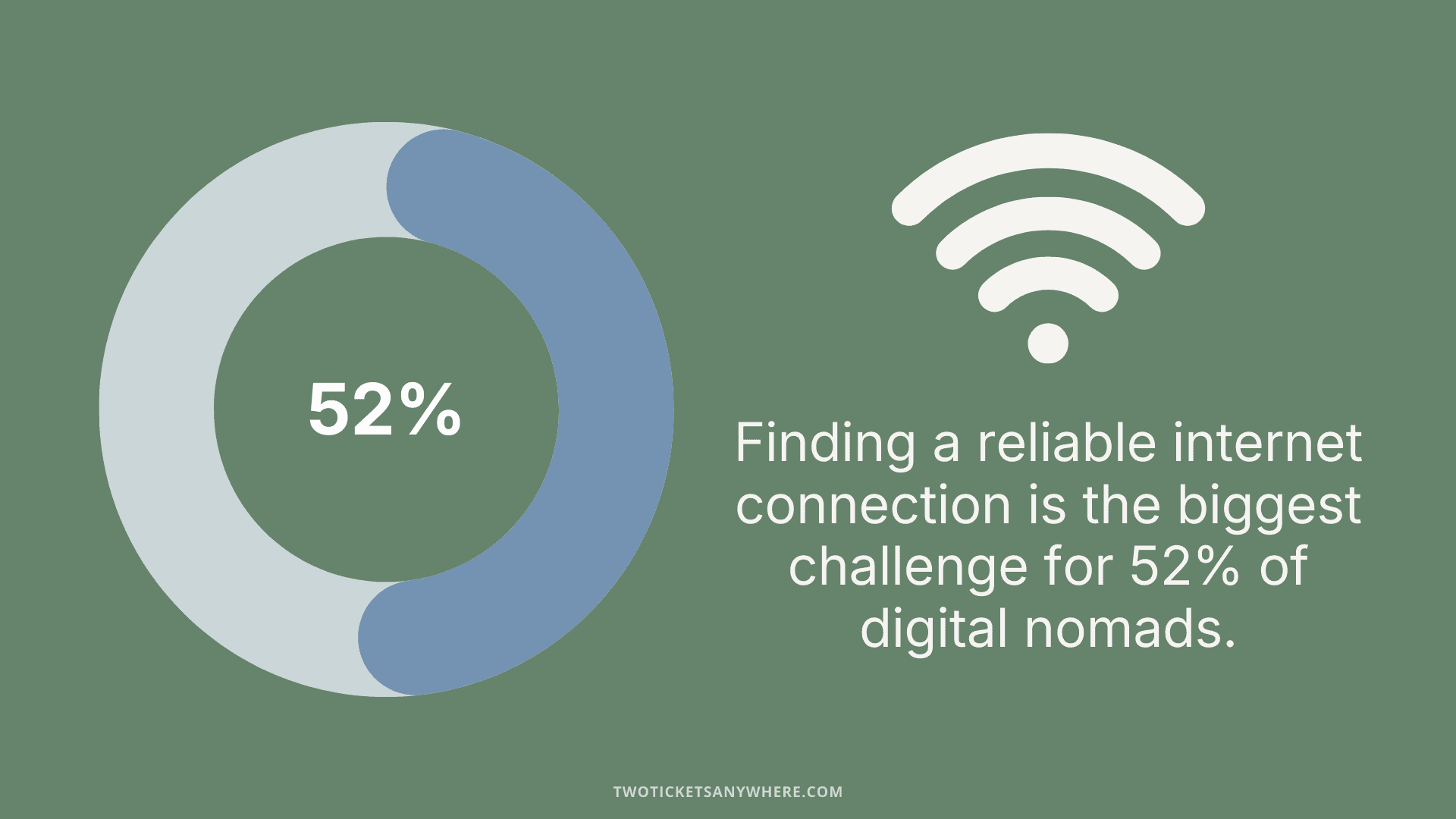
In another study, 52% of digital nomads said finding a reliable internet connection was their biggest challenge.
Being away from family and friends also causes significant stress 26% of nomads.
Time zones can also be restrictive for long-term digital nomads – especially if you are employed. 21% said that time zones work as their biggest challenge, with managing work and travel also 21%.
What’s more?
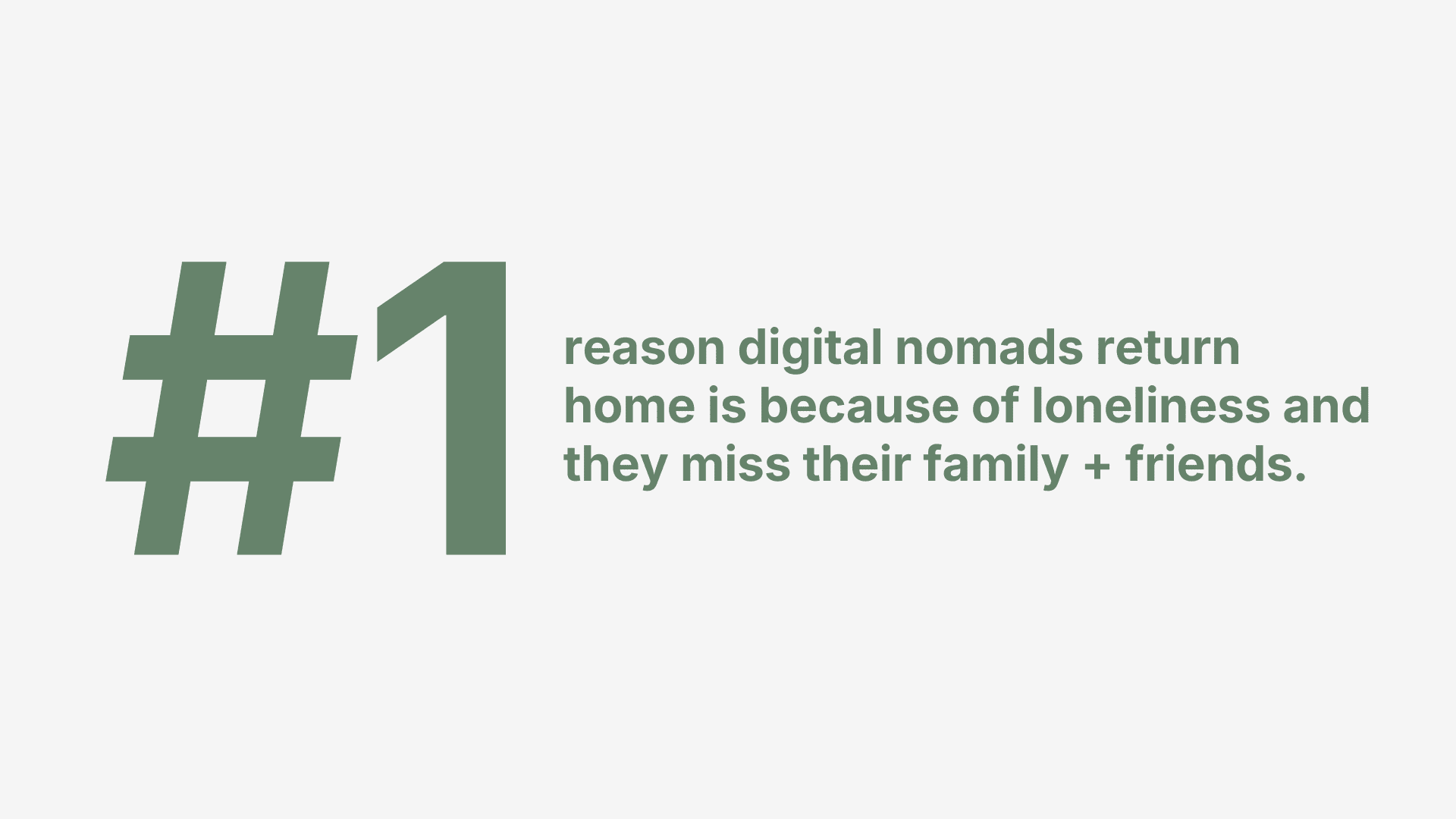
The number #1 reason digital nomads return home is that they miss their families and friends. Loneliness is a killer and if you travel as a nomad by yourself, it can become a drain on your life.
Even if you find a solid digital nomad community, sometimes you just need to return home to recharge. And that’s perfectly fine!
Top Reasons To Become A Digital Nomad
The top 5 reasons most people become a digital nomad are:
- 73% said they wanted a better work-life balance
- 68% said they love the freedom of the lifestyle
- 55% said they just love to travel
- 43% said they wanted to avoid office politics
- 37% said they had a desire to explore other cultures
There are clearly lots of reasons that push people to make the switch to the digital nomad lifestyle.
But most interestingly, the top 2 have to do with freedom and work-life balance. The flexibility to choose what you want is something that most digital nomads seem to value.
Benefits Of Being A Digital Nomad
So why do people become digital nomads in the first place?
Here’s what the data shows:
Travel freedom tops the list. 52%of digital nomads say they made the switch so they can travel where they want. Close behind, 49% wanted a better work/life balance.
But that’s not all…
48% wanted control over their travel plans. 44% craved new cultural experiences. And 41% simply wanted to meet new people.
Bottom line:
It’s all about freedom and flexibility.
What Is A Digital Nomad?
A digital nomad is someone who embraces a location-independent lifestyle.
They have no specific home base and use technology to work remotely while travelling and exploring the world. Some digital nomads choose to stay at a pace for a few months, while others choose to move around more frequently – every few weeks.
The key thing that defines a digital nomad is the ability to be able to sustain themselves from practically any location in the world.
Most digital nomads can be broken down into a few categories:
- Freelancers
- Remote employees
- Online entrepreneurs
- Bloggers and content creators
These are just examples of what digital nomads do so they can be completely location-independent.
Digital Nomads vs Remote Workers
The remote work trend is in full swing.
Many people have realized they can work remotely from another country while still maintaining their job.
But don’t be fooled…
Remote workers are not the same as digital nomads. We always get this question, so I wanted to explain it. What’s the difference between digital nomads and remote workers?
The digital nomad lifestyle is just that – a lifestyle.
Digital nomads will move more frequently to experience life in many different cities and countries. Being a digital nomad means that you are location independent and your lifestyle is to travel constantly (being nomadic).
Remote workers are simply people that don’t work from a traditional office. You can work from your home office and still be a remote worker!
You could say that digital nomads are a specific type of remote worker. But remote working is not a lifestyle in and of itself. It just describes your work life.
I hope that makes more sense now.
Wrapping It Up
That was a lot of digital nomad statistics to take in.
The truth is that the digital nomad trend is no longer just a trend…
It’s a movement that’s already big and looks like it’s not going to slow down anytime soon.
Even countries are looking for ways to attract digital nomads because of the $940 billion economic benefits they bring.
Now I want to hear from you:
What was your favorite digital nomad statistic?
Let us know in the comments!
Frequently Asked Questions
What is a digital nomad?
A digital nomad is someone who uses technology to work remotely and has the freedom to travel and live in different locations. The key to being a digital nomad is to have a job or business that allows you to work online from anywhere in the world.
How to be a digital nomad?
To be a digital nomad, the most you need to have a job or source of income that can be done remotely. Here are some specific tips on how to be a digital nomad:
- Get a remote job that you can do online while traveling
- Choose a popular city with a strong digital nomad community
- Set up online banking and cards for easy management
- Research visa requirements and necessary paperwork
- Create a budget and track your expenses
- Consider what tech you need to travel comfortably
- Get digital nomad travel insurance that covers you wherever you go
- Join communities in coworking and coliving spaces
How many digital nomads are there?
There are 43 million digital nomads worldwide in 2026. 18.5 million digital nomads are from the United States, accounting for 43% of all nomads globally.
How much do digital nomads make?
Digital nomads earn an average salary is $124,720 per year, with the median salary at $85,000 per year. 69% of digital nomads’ annual income is between $50k and $250k. 49% of digital nomads said they earn the same or more than when they worked in traditional corporate jobs.
What are the statistics of digital nomads?
There are 43 million digital nomads worldwide. Digital nomads contribute a global economic value of $940 billion per year. If the global digital nomad movement was a country, it would rank 38th in the world in terms of population. The average age of a digital nomad is 38 years old and 58% of all digital nomads aged 25 to 44. 61% of digital nomads are employed, while 39% are self-employed.
Share this article: